Watching Coins Land Every Hour: A Farm Hand Tracks One Petahash Day
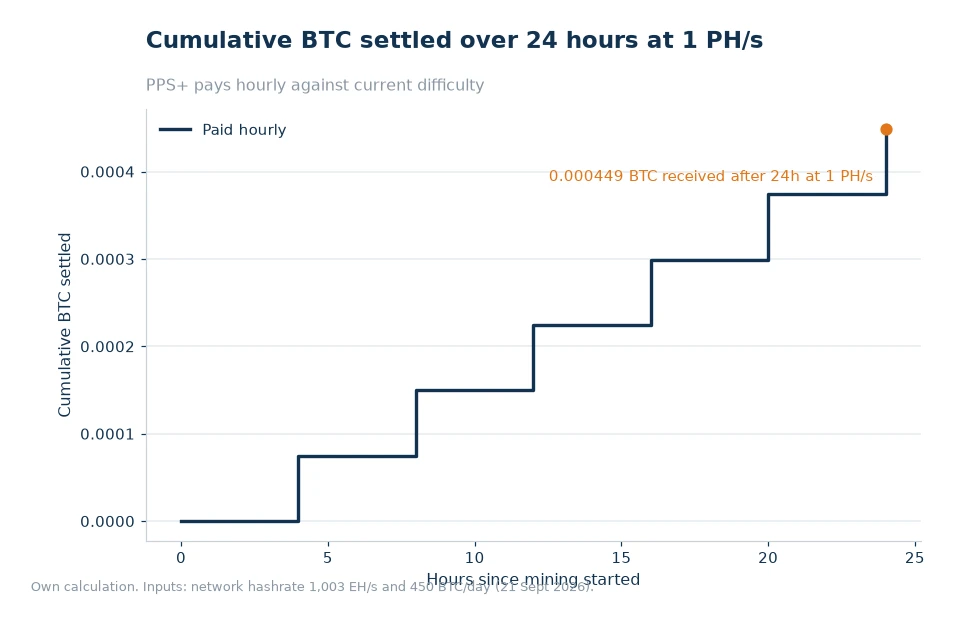
A petahash of farm capacity credits about 0.00001869 BTC each hour at current difficulty, compounding into 0.00044861 BTC across a full day, worth $37.99 at $84,692 per BTC. Because PPS+ settles hourly against the difficulty then in force, the farm office can reconcile earnings before breakfast instead of after the month. This diary follows one such day from midnight to midnight.

Key takeaways
- 1 PH/s earns 0.00044861 BTC a day; each hourly slice is 1.869e-05 BTC, about $1.58.
- After 4 hours the day holds 7.477e-05 BTC; after 12 hours 0.0002243 BTC; after 24 hours the full 0.00044861 BTC.
- Hourly PPS+ settlement means a midday outage costs only the hours actually missed.
- A full day at $84,692 prices at $37.99 gross, before the listed settlement rate and power.
Midnight: the day opens at zero
The logbook starts empty at 00:00 with the halls at their coolest and every machine hashing. One petahash against a network near 1,003 EH/s owns a fixed sliver of the 450 BTC daily issuance, and the pool converts that sliver into an hourly credit without waiting for blocks to mature. Nobody in the building needs to understand difficulty at 132.76 T to do their job; the night technician only needs to know that silence from a rack costs roughly $1.58 an hour at current price.
That hourly rhythm shapes staffing more than any slogan. Rounds happen on the hour because credits happen on the hour, and a fan failure found at 02:10 costs one partial slice rather than a lost day. The farm's edge over a garage is not cheaper coins but faster hands: twenty minutes of downtime here is a rounding error, while at home it waits until morning.
Morning checkpoint: four and eight hours in
By 04:00 the account holds 7.477e-05 BTC, four slices of 1.869e-05 stacked neatly. At $84,692 that stack is worth about $6.33, already enough to cover the night's ventilation power on a decent tariff. The supervisor compares the figure against the ViaBTC Mining Farms operations view, where hosted capacity and self-run halls share the same reporting style, and signs off the night shift with a number rather than a feeling.
At 08:00 the cumulative reaches 0.00014954 BTC, near $12.66. Breakfast conversation turns to intake temperatures, because a hall that drifts five degrees warmer by noon will show it in the afternoon's rejected-share rate. Coins accrue regardless, yet heat shaves the edges: throttled machines hash less, and hashing less credits less. The morning walk therefore protects the afternoon's slices.
Midday wobble and the afternoon recovery
No farm day runs perfectly straight. A utility voltage dip at 11:20 reboots a row of power supplies, and twelve minutes of that row's output evaporates. Under hourly settlement the damage is contained to the affected hour's slice; there is no multi-day penalty, no luck debt, no waiting for confirmations to learn the cost. The log records the gap, the electrician logs the cause, and the 12:00 cumulative still reads 0.0002243 BTC, about $19.00.
Afternoon procedure is deliberately dull: filters checked, hot aisles walked, firmware flags reviewed. By 16:00 the total stands at 0.00029907 BTC and by 20:00 at 0.00037384 BTC, each four-hour block adding near $6.33 at current price. The listed settlement rate card explains the pool's own deduction, the listed 4% on the PPS-settled block-reward slice, which the office applies after gross rather than during the hourly watch.
Reconciling the full 24 hours
Midnight closes the book at 0.00044861 BTC, $37.99 gross. The arithmetic behind it never changed all day: 1,000 TH/s divided by 1,003,000,000, times 450 BTC, converted at $84,692. A junior clerk can verify it with the pool earnings calculator in under a minute, which is precisely the point. When verification is cheap, disputes stay rare and short.
Power accounting follows the same cadence. A petahash near 20 joules per terahash draws about 20 kW, or 480 kWh across the day; at six cents that is $28.80 against the $37.99 gross. Farm tariffs, cooling overheads and hosting fees adjust the comparison, but the structure holds: coins first, costs second, margin third. Days when the margin thins are visible by breakfast, not discovered at invoicing.
Night rounds follow a fixed loop so nothing depends on who holds the torch. The technician walks the cold aisle first, feeling for dead airflow and listening for the distinctive silence of a tripped supply, then checks the row-level ammeters against the posted baseline before ever opening a laptop. Only then comes the dashboard comparison: reported hashrate versus the 1 PH/s expectation, rejected-share rate versus the 1 percent ceiling, and intake temperature versus the posted limit. Three senses, three numbers, fifteen minutes, and the night is either cleared or escalated with specifics.
The spares shelf is sized by failure frequency, not optimism. Power supplies and fans die first and cheapest, so the farm stocks several of each beside thermal paste, ethernet cables and one spare control board per machine generation. A failed fan swapped in twenty minutes costs a single hourly slice; the same failure waiting three days for courier delivery costs seventy-two slices plus the idle hours of the technician. Inventory that looks lazy on a quiet month looks brilliant during a storm week.
Month-end reporting fits on a single page by design. Total credited BTC beside the formula prediction, total kilowatt-hours beside the tariff, uptime percentage beside the 99 percent target, and a one-line note for each incident longer than an hour. Owners who receive this page twelve times a year understand their farm better than owners who receive a hundred raw screenshots. Clarity compounds like interest; noise evaporates like heat. Hand over each shift in writing, even when the next technician is yourself tomorrow. Three lines suffice: hashrate at handover, anything touched during the shift, and anything that looked odd but not yet broken. Written handovers catch slow failures that memory smooths over.
| Hour of day | Cumulative BTC | Cumulative USD | Slices banked |
|---|---|---|---|
| 04:00, night done | 7.477e-05 | $6.33 | 4 of 24 |
| 12:00, midday | 0.0002243 | $19.00 | 12 of 24 |
| 20:00, evening | 0.00037384 | $31.66 | 20 of 24 |
| 24:00, close | 0.00044861 | $37.99 | 24 of 24 |
The table doubles as a fault detector. Any checkpoint trailing its row by more than a slice points at downtime inside that window, and the missing amount prices the incident immediately. A 04:00 figure of $4.75 instead of $6.33, for instance, confesses an hour of darkness somewhere in the night, no investigation required.
Worked example
Reproduce the day's curve from the September snapshot, slice by slice.
- Daily BTC per TH/s: 450 ÷ 1,003,000,000 = 0.00000044865 BTC.
- 1 PH/s is 1,000 TH/s: 1,000 × 0.00000044865 = 0.00044861 BTC a day.
- Hourly slice: 0.00044861 ÷ 24 = 0.00001869 BTC, shown as 1.869e-05 BTC, about $1.58.
- 4 hours: 4 × 0.00001869 = 7.477e-05 BTC, about $6.33.
- 8 hours: 8 × 0.00001869 = 0.00014954 BTC; 12 hours: 0.0002243 BTC; 16 hours: 0.00029907 BTC.
- 20 hours: 20 × 0.00001869 = 0.00037384 BTC, about $31.66.
- 24 hours: 24 × 0.00001869 = 0.00044861 BTC; 0.00044861 × 84,692 = $37.99.
Frequently asked questions
Why does the balance grow every hour instead of per block?
Under PPS+ the block-reward slice settles hourly against current difficulty, so 1 PH/s posts about 1.869e-05 BTC each hour without waiting for the pool to find blocks.
What does an hour of downtime cost at this scale?
Roughly one hourly slice, about 1.869e-05 BTC or $1.58, since settlement accrues per hour hashed and skips only the hours actually missed.
How does the office verify the day independently?
Divide 1,000 by 1,003,000,000, multiply by 450 BTC and by $84,692; a full clean day should print 0.00044861 BTC and $37.99 before fees and power.
File the day and start the next one
Log the 0.00044861 BTC, note any missing slices with their causes, and reset the sheet to zero. A farm that reconciles daily never argues monthly, because every discrepancy is caught while the technicians still remember the smell of the faulty fan. Hourly settlement rewards exactly that habit: attention, logged.
Sources: farms and fee pages for operations reporting and the listed 4% on the PPS-settled block reward with hourly PPS+ settlement; chain inputs read 21 Sept 2026 (network about 1,003 EH/s, difficulty 132.76 T, subsidy 3.125 BTC, 144 blocks a day, BTC $84,692); published 11 Nov 2026. Figures are arithmetic on those inputs[1].