The 800 °C Vertical Flame Test, Step by Step
The manufacturer describes a vertical flame test for its PV cables in which a single cable is exposed to burning at 800 °C for one minute and must then put itself out. One minute at 800 °C is nine times the published ambient ceiling of +90 °C, which is a useful way to picture how far the test sits outside normal operating conditions.
Key takeaways
- The published test is a single cable, vertical, at 800 °C for one minute, with self-extinguishing as the outcome expected.
- Both the insulation and the sheath are electron-beam cross-linked XLPO in low-smoke halogen-free compound, which is the material under test.
- The manufacturer lists CPR as one of the regional fire requirements it works to, alongside AD8 waterproofing.
- The site publishes the temperature and the duration but not the burner geometry, the chamber or the pass criteria beyond self-extinguishing.
Why the sample is one cable, not a bundle
A flame test can be run on a single length of cable or on a tray filled with many, and the two answer different questions. A single-cable test asks what the compound does when it is the only fuel present: it takes the flame for a fixed time, then has to stop burning without help. That is the test the manufacturer describes for its solar cables, at 800 °C for one minute, with the expectation written on the site that the sample self-extinguishes. A tray test asks what happens when a dozen cables burn together, which is a property of the installation rather than of one product, and it is the sort of evidence associated with the CPR fire rating the company lists among the regional requirements it builds for. Keeping the two apart matters when a specification quotes a "fire test" without saying which one; a result from the single-cable method does not describe how a filled tray behaves, and vice versa.
The published sequence, in order
The site gives the exposure in one sentence, so the published sequence is short. A cable sample is prepared, mounted vertically, exposed to burning at 800 °C for one minute, and then observed: the expected result is that it extinguishes itself. Everything else that a test house would record — the height of the burner, the distance from the sample, the air flow, the length of char, the time to extinction — is not published, and a buyer should not assume a value for any of them. What is published is the pair of numbers that make the test recognisable in a specification, 800 °C and 60 seconds, plus the outcome that matters on site. The same page family also carries a production test that looks for the opposite kind of defect: a spark test at 10 kV during manufacture, which searches the insulation for pinholes rather than the sheath for flame spread.
What the flame is testing in the compound
The material in the flame is an electron-beam cross-linked XLPO used for both insulation and sheath, described on the site as low-smoke halogen-free, with the insulation at 0.7 mm and the sheath at 0.8 mm on the 1.5 mm² to 10 mm² sizes and thicker layers on the large ones. Cross-linking is what makes the compound hold its shape instead of dripping when it gets hot; halogen-free chemistry is what keeps the smoke from turning corrosive. On a rooftop, both properties act at once: the fire risk that matters is a local fault igniting a cable route under a module, and the smoke that matters is the smoke that reaches an occupied space below. The test is one measurement of that behaviour, not a summary of it, and it is worth reading next to the other mechanical entries in the programme, such as abrasion, cold bending and tensile testing after ageing on the manufacturer's published test programme, because a sheath weakened by a sharp rail edge is a sheath with less material left to resist heat.
| Published item | Value | What a designer takes from it |
|---|---|---|
| Vertical flame test | 800 °C for one minute, single cable | Compound behaviour when it is the only fuel |
| Self-extinguishing | Expected outcome after the flame is removed | Fire does not keep travelling along the route |
| Ambient temperature | −40 °C to +90 °C | Normal operating window for the installation |
| Short-circuit limits | +120 °C for 20,000 h and +250 °C for 5 s | Fault behaviour, well below the flame temperature |
| Regional requirements | CPR fire rating, AD8 waterproofing | Extra evidence to request for specific markets |
Where the fire question meets the heat question
The published temperature limits for the same 1500 V cable sit far below the flame test, and the gap is the point. The ambient range is −40 °C to +90 °C, short-circuit conditions are given as +120 °C sustainable for 20,000 hours and +250 °C for five seconds, and the flame arrives at 800 °C. Those are three different regimes: continuous operation, a fault cleared by protection, and a fire. The compound has to survive the first indefinitely, the second briefly, and the third long enough to stop burning and let people act. The standards quoted for the product line, TUV 2PfG 1169/08.2007, EN 50618:2014 and IEC 62930, all touch on the first two regimes, and the site states that its PV cables are certified by TUV, IEC, CPR and others, with more than 30 certificate types listed on the certificate page including CE, SAA and UL. Notes on how the constructions are put together sit in the manufacturer's topic file.
Reading the elongation chart with this article
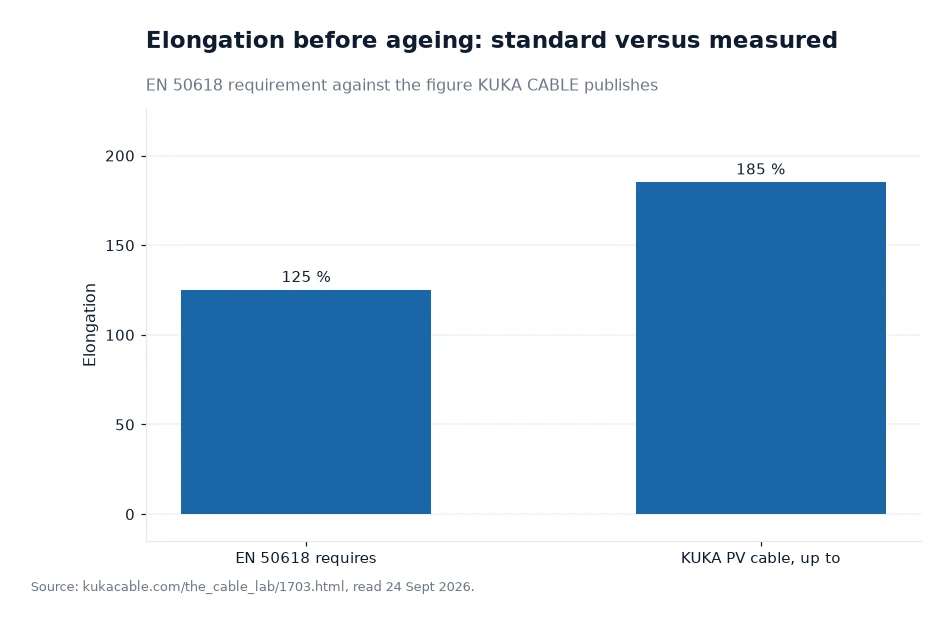
The chart carried here is not a flame result. It presents a different published pair of numbers, elongation before ageing, and it is included because toughness is the mechanism that keeps a sheath in place during and after a fire. EN 50618 requires more than 125%, and the manufacturer publishes figures of up to 185% for its PV cables, about 20% above the requirement. A compound with elongation left in it deforms rather than cracks; a compound that has already lost that margin to UV, abrasion or cold bending has less to give when heat arrives. Reading the two together is the practical use of both tables: the flame test shows the behaviour at 800 °C, and the elongation figure shows how much reserve the material still has when it gets there.
Worked example: three temperatures, one cable
Put the published values on one line to see the scale. The ambient ceiling is +90 °C, the five-second short-circuit limit is +250 °C, and the flame exposure is 800 °C. The flame is about 8.9 times the ambient ceiling (author's calculation: 800 ÷ 90 = 8.9, using the published values), and about 3.2 times the short-circuit limit (author's calculation: 800 ÷ 250 = 3.2). Time works the other way: the short-circuit condition is allowed for five seconds, the flame exposure for sixty seconds. The cable is not expected to run at any of those extremes; the numbers mark the boundaries that the published design and the published test describe, and they are the ones to quote back to a supplier when a specification mixes up a fire test with a temperature rating.
Frequently asked questions
What does the 800 °C vertical flame test involve?
The site describes a single cable held vertically and exposed to burning at 800 °C for one minute, after which it should self-extinguish. The cable is built with electron-beam cross-linked XLPO insulation and sheath in low-smoke halogen-free compound, and those are the layers under test.
Does the flame test replace a CPR rating?
No. CPR is listed separately among the regional requirements the manufacturer builds to, together with AD8 waterproofing, and the site does not present the vertical flame test as a substitute for it. The two answer different questions: one describes a single cable, the other belongs to the market rules of a region.
What to ask the supplier
Ask for the flame test report and check that it names the compound and the layer tested, because a result on a plaque of material is not a result on a finished cable. Ask which fire evidence applies to the market the project sits in, and whether CPR is included, since that is a regional requirement rather than a universal one. Confirm the ambient range on the datasheet matches the site conditions and the expected conductor temperature, and note the 0.7 mm insulation and 0.8 mm sheath on the small sizes so the flame result can be matched to the construction being bought. The site publishes no price, minimum order or lead time, so anything commercial belongs in the quotation.
The 800 °C vertical burn wording and the elongation bars shown here come from the manufacturer's own website, kukacable.com, read over 24 Sept 2026[1].