A supplier capability audit is a process, not a meeting, and the process fails most often at the two ends: it starts without a defined question and it finishes without a written gap list. For an established beauty brand, the audit has a second requirement that a startup's evaluation does not, which is that the result has to be usable by somebody who was not in the room. The seven steps below are the sequence that produces that outcome, and they work whether the supplier is a Chinese fragrance house with decades of production history or a smaller specialist. The order matters more than the individual questions, because each step determines what the next one can meaningfully ask.
Key takeaways
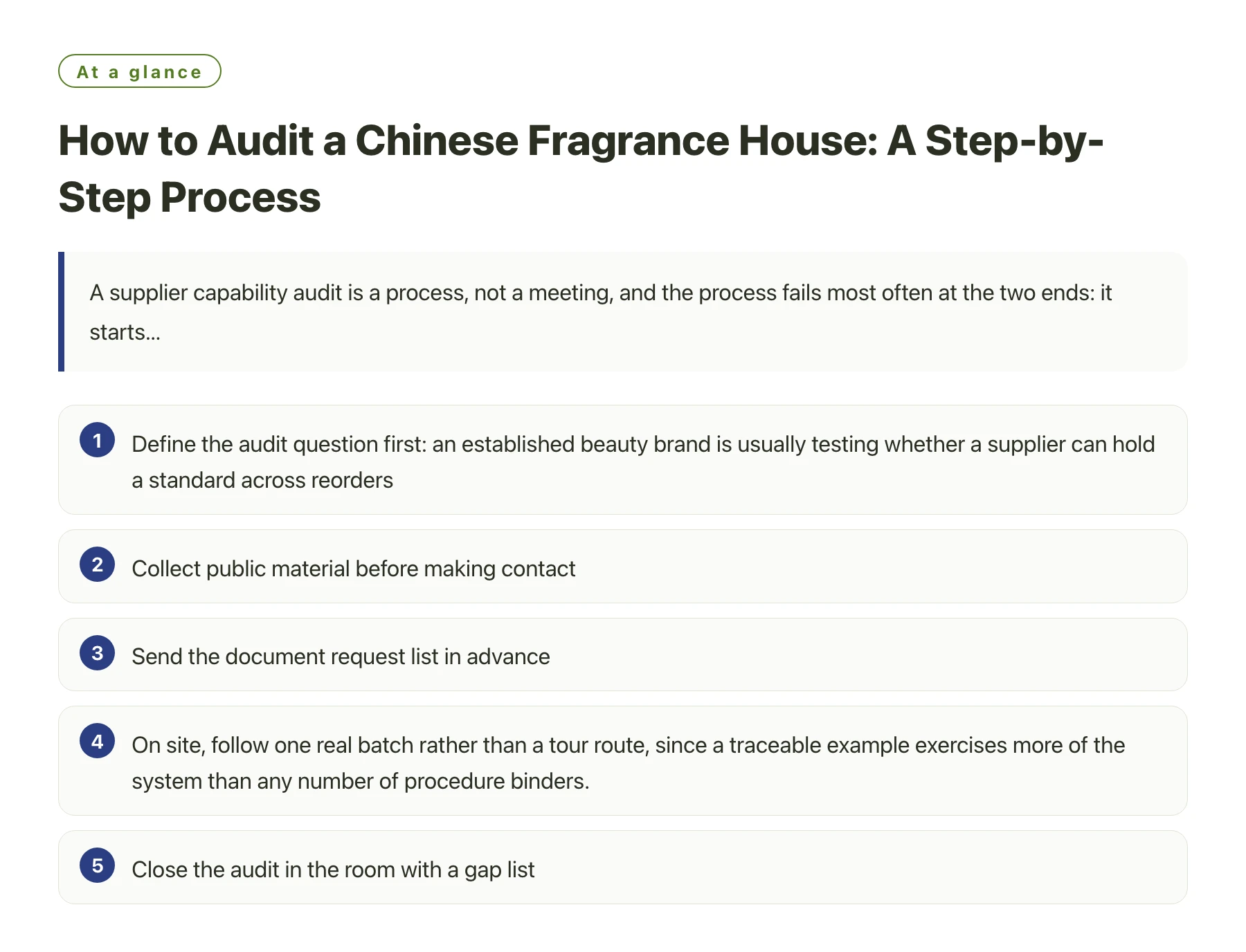
- Define the audit question first: an established beauty brand is usually testing whether a supplier can hold a standard across reorders, not whether it can make a good first sample.
- Collect public material before making contact, because what a manufacturer publishes about its own processes is itself evidence of how it documents things.
- Send the document request list in advance; a manufacturer that has the records will find them quickly, and one that does not will arrive at the visit unprepared.
- On site, follow one real batch rather than a tour route, since a traceable example exercises more of the system than any number of procedure binders.
- Close the audit in the room with a gap list, owners and dates, and treat an unanswered document question as a finding rather than a follow-up.
Most audit advice is written for either compliance teams conducting formal certification audits or founders doing their first factory visit. An established beauty brand sits between the two. It has enough internal discipline to know what a supplier file should contain, and not enough appetite to run a week-long audit on a partner it already partly knows.
The process below is therefore scaled to a single well-prepared day, preceded by document review and followed by a written close-out. It assumes the audit is about capability rather than price, and that the output has to survive a review by people in quality, regulatory and finance who each care about a different part of it.
It is written from the perspective of a quality auditor who has run this sequence on suppliers in several markets and who has learned that the step most often skipped, defining the question, is the one that decides whether the day produces anything.
The seven-step audit sequence
- Write the audit question, not the audit agendaOne sentence, agreed before anything is booked. It might be whether this supplier can hold a specification across three reorders, or whether its documentation can feed a product information file. Everything that follows is filtered through that sentence.
- Read the supplier's public material firstCertifications, process descriptions, published project notes and how clearly the manufacturer explains what it does. This is free evidence, it shapes the document request, and it tells you which questions are already answered.
- Issue the document request list in advanceSpecifications with revision history, a stability report for a comparable format, the change-notification procedure, and a worked traceability example. Sending the list early is a test in itself.
- Verify the documents on site against the requestThe visit is for confirming that the documents exist in the form described, are current, and are actually used. Ask to see them in the system rather than in a folder prepared for the visit.
- Follow one real batch end to endPick a batch, ideally from a product similar to the brand's own, and trace it backward to raw material lots and forward to the retained reference. A single traced batch reveals more than a tour of the facility.
- Interview the record ownersAsk who signs the specification, who releases a batch, and who decides when a raw material substitution is acceptable. Names and roles matter, because a system staffed by one person is a single point of failure.
- Close out with a written gap listClosed with evidence, open with an owner and a date, or accepted as a known risk. Circulate it within two working days so it is written while the detail is still fresh.
Steps two and three are where most audits quietly lose their value. A team that arrives without having read anything spends the visit asking questions the supplier has already answered in public, and a team that sends its document request on the morning of the visit will spend the day watching people search. Both mistakes compress the time available for the steps that need presence: the batch trace and the conversations with the people who own the records. A company such as a Chinese fragrance house that publishes its certifications and service scope openly makes step two quick, which is the point, because it releases time for step five.
Making the process work with a supplier in another market
Cross-border audits add three practical variables: language, distance and the assumption gap. Language is manageable if the document request is written precisely, because a translated procedure document is easy to produce and a translated batch record is not. Distance is a scheduling problem, and the answer is to consolidate rather than to visit twice.
The assumption gap is the one that causes trouble. An established beauty brand often assumes a level of documentation discipline that is standard in its home market and variable elsewhere. Testing that assumption is precisely what steps three and four are for, and it is better done with a request list than with a general question about quality systems.
The audit also produces a second, quieter output. It tells the brand how it will feel to work with this supplier for the next three years, because the way a manufacturer prepares for an audit is a sample of the way it prepares for a delivery.
Use the request list as a calibration tool
Send the same document request to every supplier under consideration. Differences in how completely and how quickly each one responds are comparable data, and they arrive before any commercial commitment. A supplier that returns a complete package with a note explaining what it could not provide is easier to work with than one that returns a polished partial answer without comment.
Where third-party testing or certification is part of the file, establish early who performed it, against which standard, and whether reports can be shared with the brand's own regulatory advisers rather than only viewed on site, because a test report and a certificate answer different questions [1].
Turn the findings into contractual language
An audit finding that stays in a report is a note. A finding that becomes a clause is a protection. Change notification, sample retention, access to test reports, the definition of a non-conformity and the process for handling one are all natural outputs of this sequence, and they are much easier to negotiate before a programme starts than after a problem appears.
It also helps to ask the questions a supplier expects a serious buyer to ask, because the answers are more revealing when the supplier recognises the conversation as evaluative rather than exploratory. The set of the questions to ask a perfume factory overlaps heavily with this audit and can be run in the same session, which keeps the visit to a single day. For brands comparing manufacturing bases rather than individual suppliers, a structured look at Xuelei alongside a domestic option makes the differences in documentation practice explicit before either is shortlisted.
Sources
- SGS: Cosmetics, Personal Care & Household Testing —— Testing, inspection and certification services for cosmetics and personal care, including microbiological, stability and safety testing aligned with cosmetics GMP.
Frequently asked questions
How long does a supplier capability audit take?
The document review can be done before any visit and typically takes less than a day for a well-organised supplier. A single on-site day covers verification, one batch trace and the interviews, provided the request list was sent in advance.
What should be requested before the audit visit?
A current specification with revision history, a stability report for a comparable format, the written change-notification procedure, and a worked traceability example. Those four documents exercise most of the system that matters to a brand.
Does an audit need to include a trial order?
Not necessarily, but a small trial order usually adds more than a second visit. It shows how the supplier handles a real query mid-project and whether documentation arrives unprompted, which is exactly what a long programme will require.
How should findings be recorded?
As a short list categorised into closed with evidence, open with an owner and a date, and accepted risk. Anything else is a note, and notes do not survive contact with the next internal review.
What is the most common finding on a first audit?
Specifications that cannot be version-identified, followed by retained reference samples that cannot be located when a question arises later. Both are simple to fix and expensive to discover during a dispute.