Response Latency: What Affects Wait Times
Wait time in a text chat is a sum, not a setting, and the parts you control are usually larger than the part you blame. A reader with sixteen one-hour sessions a month is spending 16.0 hours in chat windows, and fifteen of those minutes are spent differently at a thirty-second exchange gap than at a ninety-second one.
Key takeaways
- Five factors add up: your turn length, the reply length, the network path, local device load and how busy the service is.
- Three of the five are yours to change, and the largest is the one most readers ignore — how much text you send at once.
- Short turns feel faster even when the per-reply latency is identical, because there are more of them per minute.
- Judge latency over a week of sessions, never from a single slow reply, which is usually a local or network event.
Where the wait actually comes from
The first component is input. A long turn takes longer to generate a reply to, because there is more context to answer. The second is output: a reply asked for detail will take longer to write than a short one, and this is the component readers notice most even though it depends heavily on what they asked for. Neither is a bug; both are consequences of the size of the exchange.
The third component is the path between your device and the service, which covers your connection type, signal quality and any routing in between. The fourth is the device itself — a phone with twenty background apps competing for memory works harder on the same request than a phone with none. The fifth is shared capacity: at busy hours, requests queue alongside everyone else's, and no amount of local tuning removes that.
What you can change, and what you cannot
Your turn length belongs to you entirely. Move from a hundred-word turn to a thirty-word one and the reply length usually follows, which shortens the round trip at both ends. Device load is also fully yours: closing background apps and tabs is unglamorous and measurably effective on older hardware.
Network quality is mostly yours but not entirely. A stable connection on the same network beats switching repeatedly between mobile data and Wi-Fi, because each switch re-establishes the session. What remains outside your control is the shared load on the service, and the honest response to that is patience rather than configuration — if waits lengthen at the same time of day for several days running, the pattern is not local.
| Factor | Why it adds time | Under your control? |
|---|---|---|
| Length of your turn | Longer input means more context for the reply | Fully — shorten the turn, shorten the round trip |
| Length of the reply | Detailed answers take longer to compose than brief ones | Indirectly — it usually mirrors your own turn length |
| Connection path | Signal quality and routing vary by network and location | Mostly — stay on one stable network rather than switching |
| Local device load | Background apps compete for memory and processor time | Fully — close what you are not using |
| Peak demand on the service | Requests queue when many people are active at once | No — adjust your session time or accept it |
Two beliefs about latency are worth dropping before you try to fix anything. The first is that a slow reply means the service is struggling; usually it means the turn was long or the connection was busy. The second is that latency is a fixed property of a platform, when in practice it varies by hour, by device and by how you write. Measure your own setup across three sessions before you compare anything, because comparisons made from single replies are noise dressed up as evidence.
Worked example
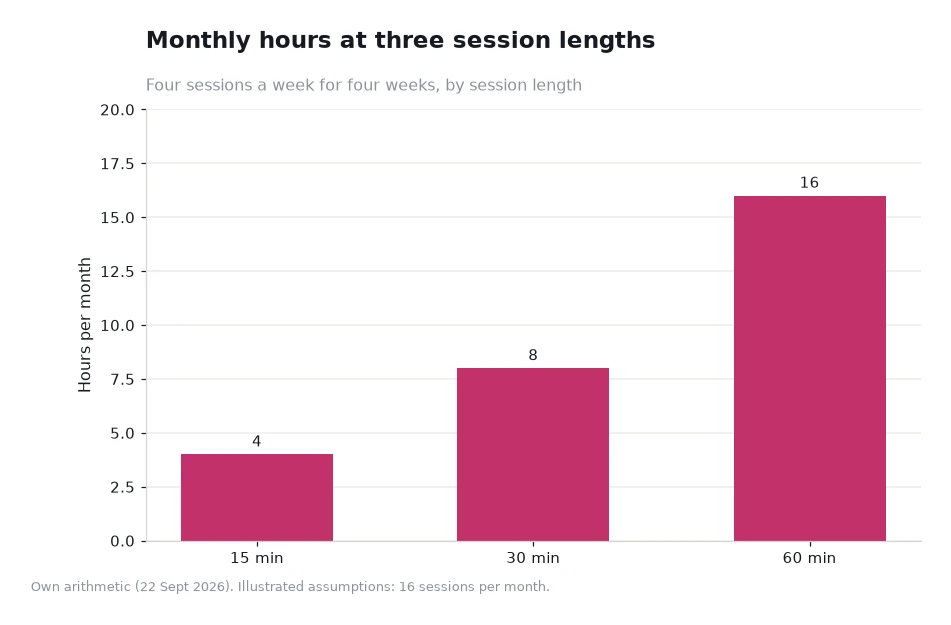
Put numbers on the arithmetic. Sixteen sessions a month: at fifteen minutes each that is 4.0 hours; at thirty minutes, 8.0 hours; at an hour, 16.0 hours. Now convert a fifteen-minute session into exchanges. Fifteen minutes is 900 seconds. If a full exchange — your turn plus the reply — takes thirty seconds, the session holds thirty exchanges. At ninety seconds it holds ten. The same quarter of an hour produces three times the conversation at the shorter gap.
That is the practical insight behind the complaint that a chat "feels slow". It rarely is; it is usually a conversation built from long turns with long replies, which produces fewer exchanges per session and makes each wait more noticeable. Halving your turn length does not halve the latency, but it multiplies the number of moments in which the conversation moves, and that is what pacing feels like from the reader's side.
One further measurement is worth taking: how many of your turns are questions. A turn that asks something produces a reply that answers it, and a session made entirely of questions reads as an interview no matter how fast the replies arrive. Counting them for a single session is usually enough to see whether the impression of slowness was really an impression of interrogation.
Measuring your own wait times
A week of light logging answers most latency questions. Note the time you send and the time the reply arrives for ten exchanges a day, and you will see two patterns: a typical gap, and occasional outliers. The typical gap is what the service does on your connection; the outliers are almost always local — a background update, a weak signal, or a device under load.
Then decide whether the number is worth acting on. Crushon describes its porn ai chat experience around responsive, adaptive replies, and the FAQ entry answering what Porn Chat AI covers sets out the same expectation: responses that read naturally rather than instantly. If your measured typical gap is a few seconds and your annoyance comes from the outliers, the fix is device hygiene rather than a different service.
Two further checks cost nothing. Run one session at a different time of day and compare typical gaps to see whether demand is the variable. And if a single character seems consistently slow while others do not, look at your own turns in that chat first — long, detailed inputs are the most common reason one chat feels heavier than the rest. The AI chat blog has longer guidance if you want to compare notes, and character search is the quickest way to find a card whose interaction style matches the shorter turns you are testing.
Frequently asked questions
Why is one reply slow when the rest are fast?
Outliers are usually local or network events: a background download, a signal dip or a device under load. A pattern repeated across sessions is more likely to be demand.
Does a shorter message get a faster reply?
Usually yes, because the reply tends to mirror the length of your turn. Shorter turns also increase the number of exchanges in a fixed session.
Should I switch networks when a chat feels slow?
Switching repeatedly re-establishes the session and often makes things worse. Stay on one stable connection and test at a different time of day instead.
Change the parts you own
Latency is best treated as an arithmetic problem with five inputs, three of which sit on your desk. Shorten your turns, close what you are not using, pick one stable connection, and measure over a week before concluding anything. Most readers who do that find the typical wait was never the problem — the shape of their conversation was.
Notes: the session-length arithmetic is illustrative, and the platform's description of adaptive responses and its AI porn chat FAQ were read 22 Sept 2026[1]. Read 22 Sept 2026. For adults aged 18 and over.